| Field | Value |
|---|---|
| RFC | 0122 |
| Title | Self-hosted runner (remote-driven local execution) |
| Status | Accepted |
| Author(s) | David Tufts (openwop-app maintainer) |
| Created | 2026-07-02 |
| Updated | 2026-07-02 — Active → Accepted (dual-witness graduation vs conformance suite 1.48.0: openwop-app reference host + MyndHyve tier-2 witness both pass the gated self-hosted-runner scenario non-vacuously behind the capability gate; see Status history). The wire surface (selfHostedRunner capability + dispatch/result/registration frame schemas + 2 protocol-tier SECURITY invariants + gated conformance scenario) is implemented and reflected in the corpus; hosts MAY now advertise selfHostedRunner. |
| Affects | new spec doc spec/v1/self-hosted-runner.md; capabilities.md (a new advertised capability); conformance (a new gated scenario); potentially SDK client types |
| Compatibility | additive |
| Supersedes | — |
| Superseded by | — |
Status note. This is
Accepted(2026-07-02) — the wire surface isimplemented and reflected in the corpus, and the gated
self-hosted-runnerconformance scenario was witnessed non-vacuously on two hosts (openwop-app
reference + MyndHyve tier-2) vs suite
1.48.0(see Status history).**Hosts MAY now advertise the
selfHostedRunnercapability and claim it in
INTEROP-MATRIX.md** once they pass the gated scenario honestly. Thecredential-non-transit and output-untrusted-transport safety rails
(
runner-credential-non-transit,runner-output-untrusted-transport) areprotocol-tier SECURITY invariants verified at the spec gate.
Summary
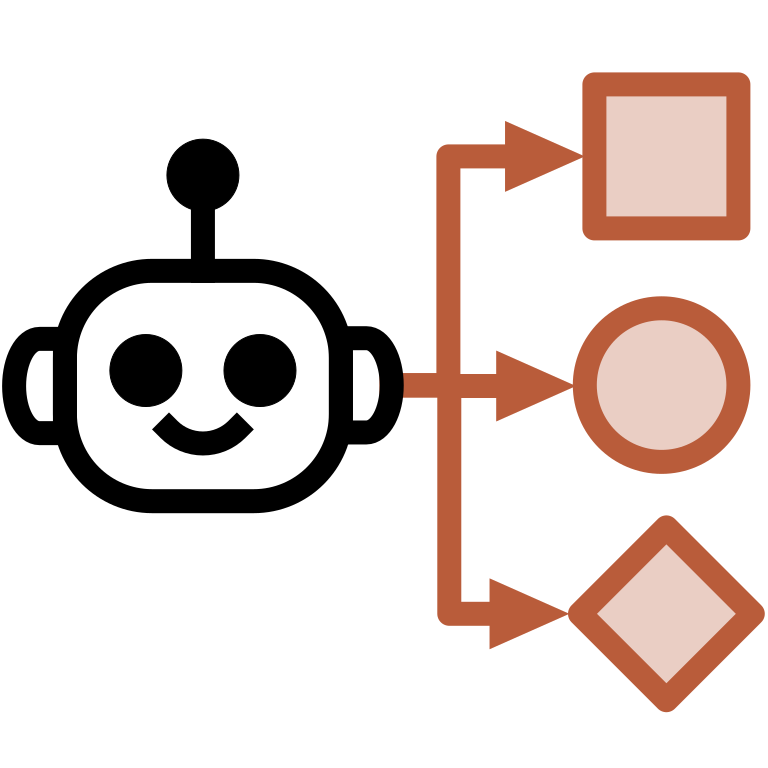
Define an OPTIONAL capability by which a host (orchestration/control plane) routes a run's model-dispatch — or a whole run — to a runner: a user-controlled process (e.g. a laptop, a clients/ daemon, a desktop app) that connects OUT to the host over a persistent channel and executes on the user's own machine. This lets a hosted control plane use compute and credentials that exist only on the user's machine (a locally-logged-in vendor CLI, a private model endpoint) without the host ever holding those credentials, and lets the user drive that local execution from anywhere (including a phone).
Motivation
Two accepted surfaces already establish the pieces but stop at the boundary a hosted control plane cannot cross:
- RFC 0108 (self-hosted / compat provider) lets a host dispatch to an
operator-configured endpoint — but only one the host can reach. A hosted (multi-tenant, cloud) control plane cannot reach a user's loopback endpoint.
- RFC 0121 (subscription provider auth) allows using a personal
subscription — but only via a client the executing process can run. On a stateless cloud host there is no such client and no user login.
The missing primitive is execution locality: a way for the executing side to be a user-controlled runner that dials the host, so the host orchestrates while the runner holds the credential and does the work. This is the same shape as CI self-hosted runners. openwop-app ADR 0182 can serve subscription auth today only when the backend is co-located with the CLI (self-hosted, same machine); this RFC is what a hosted deployment needs to offer the same thing safely.
Spec is the right layer because the runner↔host channel is a wire contract two independent implementations must interoperate over (framing, run routing, result delivery, liveness, auth of the runner to the host), and because advertising it is a capability handshake other clients must discover.
Proposal
A new OPTIONAL capability selfHostedRunner, discoverable via /.well-known/openwop, plus a runner-registration + run-routing channel.
Roles
- Host — the control plane (may be multi-tenant/cloud). Owns run identity,
persistence, and the client-facing API. Holds NO runner credential material.
- Runner — a user-controlled process that authenticates to the host, then
receives dispatch/execution work over a persistent channel and returns results. Holds the local credentials (subscription CLI login, private endpoint). Bound to exactly one owning subject (RFC 0048 principal).
Registration + channel (sketch — to be specified in self-hosted-runner.md)
- The runner opens a persistent connection to the host and authenticates with a
runner-scoped bearer minted by the host for the owning subject (never a provider credential). The host records { runnerId, subject, capabilities }.
- The channel MUST be runner-initiated (outbound), so the runner needs no
inbound network exposure — the loopback-only safety property of ADR 0182's shim is preserved end-to-end.
- Work is addressed to a runner by
runnerId(direct) or by capability match
(any free runner for the subject). Result frames carry the runId they answer.
Behavior (normative highlights — RFC 2119)
- A host MUST NOT route a run to a runner not owned by the run's subject
(tenant/principal isolation across the channel).
- A runner credential (subscription login, endpoint key) MUST NOT transit the
host or appear in any run event, result, or log (mirrors the BYOK SR-1 invariant; the host only ever sees model outputs).
- A host MUST treat a runner as untrusted transport: runner-returned content
re-entering an agent loop MUST be fenced as untrusted (consistent with the existing tool-output fencing requirement).
- Liveness: a run routed to a runner that goes away MUST fail with a
distinct, retriable error (runner_unavailable), never hang indefinitely.
- Advertising
selfHostedRunnerwithout honoring the channel MUST fail
OPENWOP_REQUIRE_BEHAVIOR=true (honest-advertisement rule).
Examples
Positive: a hosted control plane advertises selfHostedRunner; a user's desktop app registers a runner; the user (from a phone) starts a run whose model step is a subscription provider; the host routes the dispatch to the runner, which runs claude -p under the user's login and returns the completion; the host persists and streams it. The subscription token never left the laptop.
Negative (rejected): a host routes subject A's run to subject B's runner → MUST be refused (isolation). A runner attempts to attach a credential to a result frame → the host MUST strip/reject it.
Security & privacy
- Runner↔host auth is a host-minted, subject-scoped bearer — revocable,
non-provider. Compromise of the host does not yield provider credentials.
- Outbound-only runner channel: no inbound exposure of the user's machine.
- Untrusted-transport treatment of runner output (injection defense).
- The ToS posture of what the runner does (e.g. driving a subscription CLI) is
out of scope here and remains the runner operator's at-own-risk decision (RFC 0121); this RFC governs only the host↔runner contract.
Alternatives considered
- Host-reachable endpoint only (RFC 0108 as-is): cannot reach a user's
loopback from a cloud host — the exact gap this closes.
- Ship credentials to the host: rejected — violates the credential-custody
invariant and the whole point of execution locality.
- No spec (host-private): two hosts/runners could not interoperate; a
desktop runner would be locked to one host. The channel is a wire contract.
Open questions
Resolved at Active (architect-reviewed 2026-07-02, cross-reviewed by both reference-host teams — openwop-app ADR 0182 Phase 5 + a myndhyve second arm — each of whom ran it through their own architecture review; wire-shape locked). Each resolution below is normative for the forthcoming spec/v1/self-hosted-runner.md.
1. Channel transport — RESOLVED: reuse SSE. OpenWOP has no WebSocket transport; the only persistent wire shape is SSE (stream-modes.md) plus the A2A durable {taskId↔runId} record (a2a-task-state.schema.json). The runner dials OUT: a long-lived GET (SSE) to receive dispatch frames, ordinary POST to return result frames — no inbound network exposure of the runner's machine (preserving the ADR 0182 loopback-only property end-to-end). Each dispatch frame MUST carry a per-runner monotonic dispatch cursor that is a distinct sequence from the run event-log sequence (they MUST NOT be conflated — reusing the event-log seq, e.g. the RFC 0115 Capabilities-Etag-from-seq derivation, breaks resume dedup). A reconnecting runner resumes via Last-Event-ID at the batch id: (stream-modes.md §Resumption) so a dispatch is never redelivered past the runner's cursor. Because a runner side effect (a subscription-CLI turn = real spend; a tool action) is not itself idempotent, Last-Event-ID alone is insufficient: the host MUST additionally drop (not re-dispatch) any redelivered {runId, stepId} whose result is already persisted — an at-most-once host-side idempotency guarantee, defense-in-depth beyond the runner cursor. No new framing is invented. 2. Granularity — RESOLVED: per-step dispatch, not whole runs. The host routes only individual model/tool dispatch steps and remains the sole orchestration/persistence/replay authority; the runner is a stateless dispatch executor. Dispatch frame { runId, stepId, provider/model | tool, inputs }; result frame { runId, stepId, output }. Whole-run routing is rejected: it would move replay authority off-host and break POST /v1/runs/{runId}:fork. The frame shape carries both model- and tool-dispatch from v1; a host MAY implement model-dispatch first and add tool-dispatch later behind the same capability gate (openwop-app ADR 0182 Phase 5 lands model-dispatch first). 3. Replay/fork — RESOLVED: replay never re-dispatches; fork re-routes, no pin. Each dispatch result is persisted as a normal step record, so replay reads from persistence and MUST NOT re-dispatch to the runner (replay.md). A fork of a run whose steps executed on a now-absent runner re-routes future dispatch to any runner owned by the run's owning subject (the stable RFC 0048 principal the host stamps on run.metadata, NOT a fresh id) with a matching capability; it MUST NOT pin to the original runnerId. Dispatch to an absent runner fails with the distinct retriable error runner_unavailable. 4. Runner capability schema — RESOLVED. A runner registers { runnerId, subject, capabilities: { providers?: string[], models?: string[], tools?: string[] } }, where subject is the run's owning RFC 0048 principal (§3). Work is addressed by runnerId (direct) or by capability-match. Match MUST filter on subject FIRST, then capability — never the reverse — so a capability match can never route a subject's step to another subject's runner (a cross-tenant leak); the gated conformance scenario MUST assert this subject-first ordering explicitly (SR-1-adjacent). The registration record is per-subject runtime state and MUST NOT appear on /.well-known/openwop; only the selfHostedRunner: { supported: boolean, ... } discovery block does (root-level, per the RFC 0073 document-root layout, modeled on agents/connections/a2a).
Adoption / conformance
A new gated conformance scenario asserting subject-first match (a capability match never routes across subjects — OQ4), at-most-once dispatch (a redelivered {runId, stepId} with a persisted result is dropped, not re-dispatched — OQ1), credential non-transit, and runner_unavailable on liveness loss. Two new protocol-tier SECURITY invariants land in lockstep with the capability (each with a matching public test): runner-credential-non-transit (a runner credential MUST NOT appear in any dispatch/result frame, run event, result, or log — modeled on the BYOK SR-1 family + subscription-credential-user-scope-only) and runner-output-untrusted-transport (runner-returned content re-entering an agent loop MUST be fenced <UNTRUSTED> — modeled on node-pack-output-untrusted). The shape probe is always-on/server-free; the behavioral leg gates on selfHostedRunner and soft-skips when unadvertised (hard-fails under OPENWOP_REQUIRE_BEHAVIOR=true). Reference-host advertisement (openwop-app ADR 0182 Phase 5; a second witness) proceeds only once this reaches Accepted.
Status history
Active → Accepted (2026-07-02)
Graduated on dual-witness evidence vs published conformance suite @openwop/openwop-conformance@1.48.0. Per GOVERNANCE.md §"Acceptance evidence tiers" this is a tier-1 reference (openwop-app) + tier-2 (MyndHyve steward-affiliated sibling) graduation — not independent-organization dual-witness. Both witnesses are LIVE-DEPLOYED (each on a real deployed Cloud Run revision, advertising selfHostedRunner honest-off supported:false on its live /.well-known/openwop — the openwop-app row via prod app.openwop.dev, the MyndHyve row via a --no-traffic --tag witness revision) and were steward-curl-verified 2026-07-02 (discovery honest-off + the POST /v1/host/sample/runner/register seam live, HTTP 400 on a minimal payload, NOT a 404 route-absent). Both pass the gated self-hosted-runner scenario non-vacuously under OPENWOP_REQUIRE_BEHAVIOR=true (the tier-3 POST /v1/host/sample/runner/{register,dispatch} seam RUNS — register → HTTP 200, not a 404 soft-skip — driving each host's real subject-first match + real {runId, stepId} at-most-once result store, not a fabricating mock).
Witnesses:
- openwop-app reference host (tier-1) — PR openwop-app#1066 **merged to
main; live in prod at app.openwop.dev, Cloud Run rev openwop-app-backend-00363-gtg @ 100%. (CI was red only on the GitHub-Actions billing outage — jobs failed at startup with 0 steps; the local npm run ci gate is authoritative per CLAUDE.md → backend suite 3889 passed; admin-override merge.) host/selfHostedRunner.ts per-subject registry + subject-first match (no cross-subject fallback) + at-most-once {runId, stepId} dedup on a real DurableCollection; §19 seam via routes/runnerSeam.ts; advertises selfHostedRunner { supported:false→true, dispatchKinds:["model"] } (honest-off pre-flip; steward-curl-verified live honest-off). Published self-hosted-runner.test.ts 7/7 under OPENWOP_REQUIRE_BEHAVIOR=true — subject-first runner_unavailable (HTTP 409** + retriable:true) with no cross-subject fallback, and deduped:true on a redelivered {runId, stepId} backed by the persisted result. Both invariants honored (runner-credential-non-transit: closed frames, token stays on the runner; runner-output-untrusted-transport: output fenced <UNTRUSTED>). Model-dispatch arm first (ADR 0182 Phase 5); the SSE outbound-dial product channel is deferred. No vendor-CLI spawn in backend/src (ADR 0182 gate holds).
- MyndHyve
workflow-runtime(tier-2) — PR myndhyve#192. Live-deployed
witness revision workflow-runtime-00516-yuz (tag rfc0122, 0% traffic — prod serving untouched, RFC 0115 witness pattern; steward-curl-verified live honest-off selfHostedRunner { supported:false, dispatchKinds:["model","tool"] } + seam live register → 200). host/selfHostedRunner.ts SSOT: subject-first match keyed on the RFC 0048 Principal (filters subject before capability, no cross-subject fallback) + at-most-once {runId, stepId} dedup on a real persisted store (same idempotency shape as its run_claims registry) + a loopback runner that really answers so the dedup leg is non-vacuous. Published @openwop/openwop-conformance@1.48.0 --filter self-hosted-runner 16 passed / 0 failed under OPENWOP_REQUIRE_BEHAVIOR=true (OPENWOP_OPTED_OUT_PROFILES=openwop-self-hosted-runner, supported:false pre-flip; tier-3 seam RUNS register → 200, not a 404 soft-skip). Non-vacuity independently re-proven live via curl with fresh identifiers: subject-first register-subjB → dispatch-subjA → 503 {error:{code:"runner_unavailable",retriable:true}} (no cross-subject fallback); first dispatch deduped:false → redelivery deduped:true; result output fenced <UNTRUSTED>…</UNTRUSTED> + contentTrust:"untrusted" (runner-output-untrusted-transport); closed frames, no credential field (runner-credential-non-transit).
Status-status flip note. The runner_unavailable numeric HTTP status is host-chosen (any >= 400): the conformance witness asserts the envelope { error: { code: "runner_unavailable", retriable: true } } (as written 2026-07; the canonical shape is flat — { error: "runner_unavailable", message, details: { retriable: true } } — per rest-endpoints.md §"Error response shape", restated 2026-08-16 (S22); the RFC text is left as the dated record), NOT a fixed status (mirrors run_forbidden / capability_required; registered in rest-endpoints.md §"Common error codes" per #815). openwop-app returns 409, MyndHyve returns 503 — both conformant, both witnessed non-vacuously; the two reference witnesses at 409/503 demonstrate the envelope-not-status contract holds cross-host.
Draft → Active (2026-07-02)
Promoted under the bootstrap-phase steward waiver per CONTRIBUTING.md §"Bootstrap-phase notes" + MAINTAINERS.md §"Bootstrap-phase RFC waivers" — the same path RFC 0031 / 0046 / 0095 / 0108 / 0121 used. The 7-day comment window is waived (single-steward bootstrap repo; zero external reviewers). This promotion is non-normative — a status change only; no wire, schema, or behavior change lands in this commit.
Evidence at promotion:
- Classification firm —
additiveperCOMPATIBILITY.md§2.1: a new OPTIONAL
root capability + a new spec doc + new gated scenarios + two RFC-authorized SECURITY invariants. No existing required field, event shape, endpoint contract, error code, or MUST is touched. Hosts that omit selfHostedRunner stay fully v1-compliant; no version-negotiation impact.
- Wire-shape locked — the four Open questions are resolved above (SSE outbound
transport + monotonic dispatch sequence; per-step dispatch granularity; replay- from-persistence + no-pin fork + runner_unavailable; the selfHostedRunner discovery block + off-wire runner registration record). Architect-reviewed 2026-07-02; no shape change expected before Accepted.
- Safety rail preserved at the implementation gate. No host may advertise or
claim selfHostedRunner until Accepted; reference hosts may wire the channel behind the capability gate (seam-wired, soft-skipping) at Active.
- Path to
Active → Accepted: landspec/v1/self-hosted-runner.md+ the
selfHostedRunner capability in capabilities.md + the schemas + the two SECURITY invariants + the gated conformance scenario (published in a conformance bump); then a dual reference-host witness (openwop-app ADR 0182 Phase 5 + a second host) passes the gated scenario non-vacuously and honestly advertises.
Draft (2026-07-02)
Authored to open the design and unblock the deferred Phase 5 of openwop-app ADR 0182 (self-hosted subscription-CLI execution driven from a remote/hosted control plane), closing the execution-locality gap RFC 0108 (host-reachable endpoint only) and RFC 0121 (needs a local client) leave open (PR #812).