| Field | Value |
|---|---|
| RFC | 0006 |
| Title | Run Orchestrator |
| Status | Accepted |
| Author(s) | David Tufts (@davidscotttufts) |
| Created | 2026-05-01 |
| Updated | 2026-05-11 (Active → Accepted: integration-seams audit closed via docs/MULTI-AGENT-INTEGRATION-GAPS.md archive; conformance scenarios pass against SQLite reference host) |
| Affects | schemas/orchestrator-decision.schema.json, schemas/run-orchestrator-decided-event.schema.json, schemas/run-snapshot.schema.json, schemas/run-event.schema.json, spec/v1/replay.md, spec/v1/capabilities.md |
| Compatibility | additive |
| Supersedes | — |
| Superseded by | — |
Summary
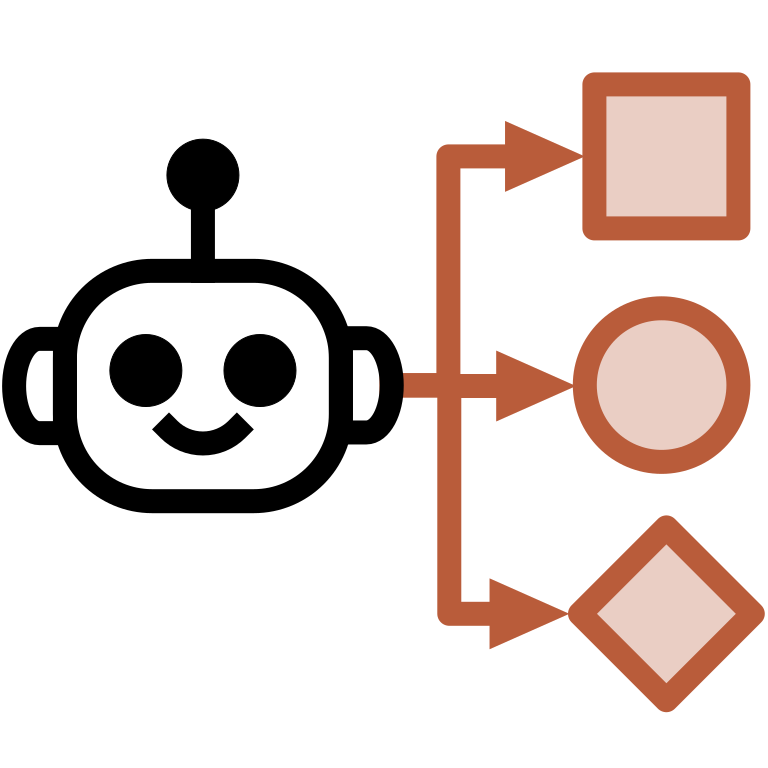
Introduce runOrchestrator — an optional supervisor agent that owns workflow routing decisions and dynamically constructs the node stack based on user intent. The orchestrator emits typed decisions (next-worker, ask-user, terminate) via a single new event type, runOrchestrator.decided. A runOrchestrator field on RunSnapshot and three ordering invariants make the surface replay-deterministic.
Motivation
The v1 baseline executes a static DAG: workflow definitions list nodes and edges, and the engine traverses them. This is the right model for deterministic pipelines (data ETL, build pipelines, fixed approval flows). It does _not_ fit orchestrator-driven agent workflows where:
- The next worker depends on what the supervisor decides after reasoning.
- Termination is a goal-judgement, not a graph-edge.
- "Ask the user a clarifying question" is a routing decision, not a node type.
Rather than re-encoding these as edge conditions in a static DAG (which forces every possible branch into the workflow definition), RFC 0006 introduces a supervisor agent that emits typed decisions at runtime. The static DAG still exists — workers are nodes — but routing between workers is driven by the orchestrator.
This is observable via a single event type (no implicit branching), replay-deterministic (decisions are cached), and bounded (terminate-vs-fail-vs-cancel are distinct states).
Proposal
§A runOrchestrator field on RunSnapshot
Add an optional object to the run snapshot:
   "properties": {
     "runId": { ... },
     "workflowId": { ... },
+    "runOrchestrator": {
+      "type": "object",
+      "required": ["agentId"],
+      "properties": {
+        "agentId": { "type": "string", "minLength": 3, "maxLength": 256 },
+        "iterationCap": { "type": "integer", "minimum": 1 },
+        "decisionsTaken": { "type": "integer", "minimum": 0, "default": 0 }
+      },
+      "additionalProperties": false
+    }
   }
When runOrchestrator is present:
agentIdMUST be set at first decision and MUST NOT change for the run's lifetime.iterationCapMAY cap total orchestrator decisions per run (independent ofrecursionLimit).decisionsTakenis host-incremented; clients MAY treat as read-only.
When runOrchestrator is absent, the run executes as a v1 static-DAG run; no orchestrator events fire.
§B OrchestratorDecision shape
Defined in orchestrator-decision.schema.json. Three canonical kinds; the enum is closed at the protocol layer. Vendor extensions MAY ship under vendor.<host>.<kind> per host-extensions.md but conformance validates against the closed set.
next-worker
{ "kind": "next-worker", "nextWorkerIds": ["string", ...] }Dispatches one or more workers. Phase-5 hosts MAY treat nextWorkerIds as length-1 and ignore the tail; Phase-6 hosts (with core.dispatch per RFC 0007) SHOULD honor full fan-out.
nextWorkerIds entries are either node IDs (resolve directly to nodes in the run's static DAG) or agent IDs (resolve via the workflow's agent-to-node binding). Host capability advertisement (capabilities.orchestrator.workerIdInterpretation: "node" | "agent" | "either") tells clients which form to send.
ask-user
{ "kind": "ask-user", "prompt": "string" }Routes a human-targeted question. Hosts that advertise capabilities.conversationPrimitive: true (RFC 0005) SHOULD route through conversation.exchange; hosts that don't MAY surface as a 'clarification' interrupt. The dispatch layer (RFC 0007 §B) makes the routing choice.
terminate
{ "kind": "terminate", "reason": "string (optional)" }Clean run termination driven by orchestrator judgement. Distinct from:
run.failed— uncaught executor error (involuntary).run.cancelled— operator cancellation via REST (external).terminate— orchestrator-emitted goal-reached signal (voluntary, in-band).
Common reasons (not normated): 'goal-reached', 'max-iterations', 'unrecoverable-error'.
§C runOrchestrator.decided event
Emitted exactly once per decision. Payload defined in run-orchestrator-decided-event.schema.json:
{
  "agentId": "string (matches runOrchestrator.agentId)",
  "decision": "<OrchestratorDecision>"
}
The event envelope's top-level nodeId carries the supervisor node ID; the payload does not duplicate it.
§E Ordering invariants (CO-1 / CO-2 / CO-3)
Named for cross-host conformance:
CO-1: Decision-then-effect. runOrchestrator.decided MUST be persisted _before_ any event reflecting its effect:
- For
next-worker: before thenode.startedof the dispatched worker. - For
ask-user: before theconversation.openedorclarification.requested. - For
terminate: before therun.completed.
CO-1 lets replay reconstruct the decision causation chain from the event log alone.
CO-2: Identity stability. RunSnapshot.runOrchestrator.agentId MUST equal the agentId on every runOrchestrator.decided event for the run's lifetime. Hosts MUST reject decisions from any other agent with validation_error.
CO-3: Iteration cap. When iterationCap is set, the (iterationCap + 1)th decision MUST fire cap.breached with kind: 'orchestrator-iterations' and transition the run to failed. The capped run does NOT terminate cleanly — it fails so operators investigate.
§F Replay determinism (cache-only)
Replay re-folds runOrchestrator.decided events from the event log; the orchestrator agent is NOT re-invoked during replay. This is the "cache-only" determinism rule: orchestrator logic MAY be non-deterministic (LLM-driven), but the cached decision is replayed verbatim.
Replay divergence: if the underlying workflow definition has changed such that the cached nextWorkerIds[i] no longer resolves, the host MUST emit replay.diverged and either abort or continue per replay.md §Divergence handling.
§G Capability advertisement
{
  "capabilities": {
    "orchestrator": {
      "supported": true,
      "workerIdInterpretation": "node" | "agent" | "either",
      "fanOutSupported": false
    }
  }
}
Hosts that do not advertise capabilities.orchestrator.supported: true MUST reject workflow definitions that reference core.orchestrator.supervisor node types with validation_error at registration time.
§H Termination state matrix
| Outcome | Run state | Trigger |
|---|---|---|
| Clean goal-reached | run.completed | terminate decision |
| Iteration cap | run.failed (cap.breached) | CO-3 |
| Uncaught error | run.failed | executor exception |
| Operator cancel | run.cancelled | POST /v1/runs/{runId}:cancel |
| Conversation timeout | run.failed (or run.completed with null outcome — host policy) | RFC 0005 §I |
terminate is the only orchestrator-emitted _clean_ outcome.
Compatibility
Additive.
runOrchestratoris optional onRunSnapshot; pre-RFC runs omit it.- The
runOrchestrator.decidedevent type extendsRunEventType; consumers fold unknowns best-effort. - Capability is opt-in; hosts that don't advertise are still v1-conformant.
- No changes to existing required fields.
Conformance
Existing scenarios touching the area:
conformance/src/scenarios/multi-node-ordering.test.ts— verifies general event ordering. CO-1 ordering is a stricter sub-property.
New scenarios required for Accepted:
orchestrator-ordering.test.ts— exercises CO-1 across all three decision kinds.orchestrator-identity-stability.test.ts— exercises CO-2 (rejects mismatched agentId).orchestrator-iteration-cap.test.ts— exercises CO-3 (cap breach firescap.breached+ failure).orchestrator-replay.test.ts— exercises §F (replay re-folds without re-invocation).orchestrator-termination-distinct.test.ts— exercises §H (terminate is distinct from failed/cancelled).
All gated on capabilities.orchestrator.supported: true.
Alternatives considered
1. Encode routing as edge predicates in WorkflowDefinition. Rejected: forces every possible branch into the static workflow, defeats the orchestrator pattern. Works for narrow rule engines, not for LLM-driven supervisors. 2. Make orchestrator a tool exposed to LLM nodes. Rejected: routing decisions are graph-level operations, not data-level. A tool returning "next-worker: X" still needs the engine to dispatch X; the orchestrator IS the dispatcher. 3. Use Temporal-style child workflow per decision. Considered for RFC 0007's core.dispatch. The decision shape itself stays in the protocol; how to dispatch is RFC 0007's concern. 4. Closed enum vs open for decision kinds. Closed. Vendor extensions allowed under vendor.* namespace per host-extensions.md, but conformance validates against the closed canonical set.
Unresolved questions
1. Should nextWorkerIds entries be node-ids or agent-ids? Hosts advertise via workerIdInterpretation; the protocol accepts either. This is intentionally late-bound. (Tracked from orchestrator-decision.schema.json description.) 2. Should the orchestrator agent be allowed to read the full event log (audit-trail access)? Probably yes, gated on host policy. Spec stays silent. 3. Should terminate.reason be a closed enum for cross-host catalog purposes? Currently open per the schema. Defer to v1.2 if there's appetite.
Implementation notes (non-normative)
- The reference TypeScript host implements orchestrator as a special node type (
core.orchestrator.supervisor) that wraps an LLM call. The LLM returns aOrchestratorDecision; the wrapper persists therunOrchestrator.decidedevent and yields back to the engine. - Hosts MAY pre-validate decisions client-side (in the SDK) before submitting to the engine; the engine MUST re-validate server-side because the SDK is untrusted.
Acceptance criteria
- [ ] Spec text merged.
- [x]
orchestrator-decision.schema.jsonpublished. - [x]
run-orchestrator-decided-event.schema.jsonpublished. - [x]
run-event.schema.jsonincludesrunOrchestrator.decided. - [ ]
run-snapshot.schema.jsonaddsrunOrchestratorfield. - [ ]
capabilities.mdaddscapabilities.orchestrator.*. - [ ] Five conformance scenarios.
- [ ] CHANGELOG entry.
- [ ] Reference host implements an orchestrator and passes scenarios.
References
schemas/orchestrator-decision.schema.jsonschemas/run-orchestrator-decided-event.schema.jsonspec/v1/replay.md(cache-only replay rule for non-deterministic orchestrators)- RFC 0002 (Agent Identity), RFC 0005 (Conversation —
ask-userrouting), RFC 0007 (Dispatch — translates decisions into runtime actions)