| Field | Value |
|---|---|
| RFC | 0007 |
| Title | Dispatch (core.dispatch Node Pattern) |
| Status | Accepted |
| Author(s) | David Tufts (@davidscotttufts) |
| Created | 2026-05-01 |
| Updated | 2026-05-11 (Active → Accepted: integration-seams audit closed via docs/MULTI-AGENT-INTEGRATION-GAPS.md archive; conformance scenarios pass against SQLite reference host) |
| Affects | schemas/dispatch-config.schema.json, schemas/workflow-definition.schema.json, spec/v1/node-packs.md (reserved typeIds), spec/v1/capabilities.md |
| Compatibility | additive |
| Supersedes | — |
| Superseded by | — |
Summary
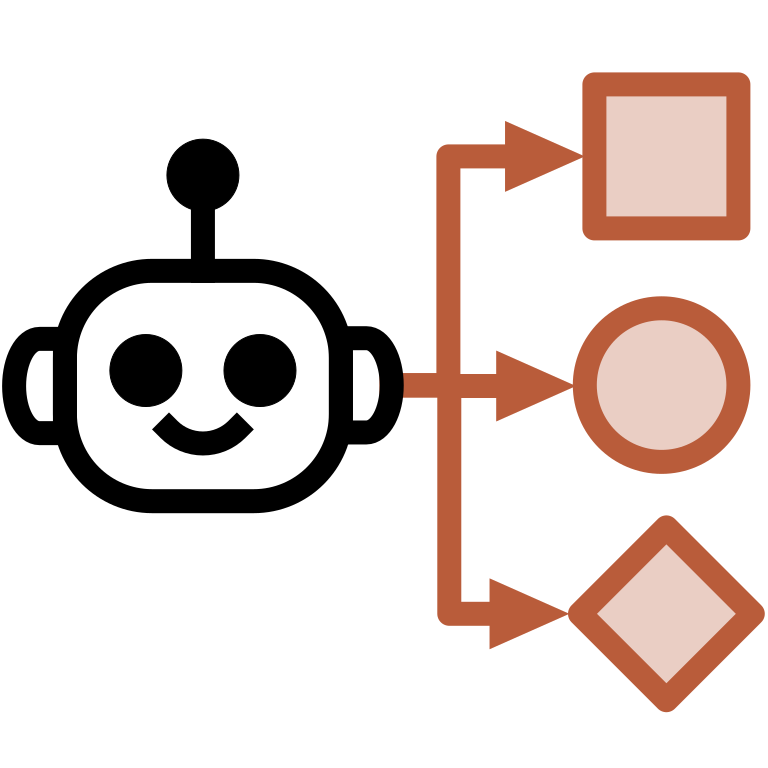
Introduce a new reserved node typeId, core.dispatch, that translates the latest OrchestratorDecision (RFC 0006) into a concrete runtime action — dispatching a worker via core.subWorkflow, asking the user via conversation.exchange or clarification.requested, or terminating the run. Configuration is pinned at workflow definition time via DispatchConfig (dispatch-config.schema.json).
Motivation
RFC 0006 defines _what_ the orchestrator decides; it does not define _how_ a decision becomes runtime work. Without a normative dispatch node, hosts will invent their own conventions: which subsystem fires the worker, which interrupt routes the user prompt, how fan-out behaves, whether iteration is capped. That divergence breaks cross-host workflow portability — a workflow built against one host's dispatch convention fails to run on another.
core.dispatch is the canonical translator. It consumes the run's latest runOrchestrator.decided event and emits the corresponding side effect. Workflow authors place a core.dispatch node after an orchestrator-supervisor node; the dispatch node's per-kind behavior is pinned by DispatchConfig.
This is symmetrical to how core.subWorkflow translates a sub-workflow reference into a child run — a reserved typeId with a normated config schema.
Proposal
§A core.dispatch typeId
Reserve core.dispatch as a canonical node typeId per node-packs.md §"Reserved core typeIds". Hosts that advertise capabilities.orchestrator.supported: true (RFC 0006) MUST implement core.dispatch.
Workflow definition shape:
{
  "nodeId": "dispatch-1",
  "typeId": "core.dispatch",
  "config": "<DispatchConfig>"
}
§B DispatchConfig shape
Defined in dispatch-config.schema.json. Four fields, all optional:
{
  "askUserRouting": "conversation" | "clarification" | "auto",
  "workerDispatchModel": "child-run",
  "fanOutPolicy": "sequential" | "reject",
  "iterationCap": 25
}
askUserRouting
Routing surface for kind: 'ask-user' decisions:
'conversation'— usesconversation.exchange(RFC 0005). REQUIREScapabilities.conversationPrimitive: true.'clarification'— usesclarification.requestedinterrupt (pre-RFC-0005 path).'auto'(default) — selectsconversationwhen the host advertises the capability,clarificationotherwise.
Hosts that select 'conversation' without advertising the capability MUST surface validation_error at workflow registration time.
workerDispatchModel
How kind: 'next-worker' is dispatched:
'child-run'(default and only v1.x value) — eachnextWorkerIds[i]resolves to a workflow id and is dispatched as a child run via the existingcore.subWorkflowmachinery.
Same-run DAG navigation (resolving worker IDs against the parent run's node graph) is out of scope for v1.x and deferred to a future RFC. Hosts MAY add vendor-extension dispatch models under vendor.<host>.<model>; conformance scenarios validate 'child-run' only.
fanOutPolicy
Behavior when nextWorkerIds.length > 1:
'sequential'(default) — dispatches each in array order, blocking on each child terminal before starting the next. The dispatch node's output reports the LAST child's(childRunId, childStatus); intermediate child-run identifiers surface in the run's event log via standardnode.*events.'reject'— fails the dispatch with a structured'fan_out_unsupported'error envelope.
Parallel fan-out is out of scope for v1.x (see §K3).
iterationCap
Optional hard cap on dispatch-node executions per run, across all dispatch nodes. When set:
- Engine MUST emit
cap.breachedwithkind: 'dispatch-iterations'once exceeded. - Run transitions to
'failed'. - Cap is independent of
RunOptions.configurable.recursionLimitandCapabilities.limits.maxNodeExecutions.
When absent, the run-level recursionLimit cap applies normally (each dispatch counts as one node execution against the run total).
§C Reading the latest decision
core.dispatch reads the latest runOrchestrator.decided event from the run's projection at execution time. If no such event exists, the dispatch node MUST fail with 'no_pending_decision' and the run transitions to failed (with cap.breached not applicable — this is a workflow-authoring error).
Hosts MAY surface a more specific error envelope when the decision is found but its kind is not yet supported by the dispatch model. Currently, only the three RFC 0006 §B kinds are supported.
§D Per-kind semantics
next-worker
1. Engine validates each nextWorkerIds[i] resolves to a workflow id (per workerDispatchModel: child-run). 2. Engine constructs a child run via the normal core.subWorkflow flow for the first ID (or all IDs sequentially per fanOutPolicy). 3. Dispatch node's output: { childRunId, childStatus } for the last child. 4. On any child failure, dispatch node propagates failure to the parent run (default subWorkflow propagation semantics). 5. For each spawned child, the host MUST emit a node.dispatched RunEvent carrying { childRunId, childWorkflowId, childStatus } (see schemas/run-event-payloads.schema.json $defs.nodeDispatched). The envelope's nodeId carries the dispatching core.dispatch node-id; the payload does NOT duplicate it. Observers MAY rely on this event to reconstruct the parent → child linkage without scanning the runs table.
ask-user
1. Engine consults askUserRouting config + advertised capability. 2. Engine emits the appropriate interrupt (conversation.opened with initialTurn containing the decision's prompt, OR clarification.requested with a single question). 3. Engine suspends the dispatch node until resume. 4. Dispatch node's output: the user-provided answer (last turn for conversation; clarificationResolved.answers[0] for clarification).
terminate
1. Engine emits run.completed with optional reason from the decision. 2. Dispatch node's output is the run's terminal outcome. 3. Any sibling nodes still in flight are cancelled per existing cancellation cascade rules (interrupt-profiles.md §Parent-child cascade).
§E Causation chain
core.dispatch's emitted events MUST set causationId to the eventId of the consumed runOrchestrator.decided event. This lets replay reconstruct the decision-to-effect chain even when events from concurrent runs interleave.
§F Replay determinism
core.dispatch is deterministic given the cached decision: same decision in → same dispatch action out. The non-determinism is upstream (in the orchestrator); RFC 0006 §F covers that. Replays re-fold the dispatch node's outputs from the event log without re-invoking subworkflows or re-asking users.
§G Capability advertisement
{
  "capabilities": {
    "dispatch": {
      "supported": true,
      "models": ["child-run"],
      "fanOutSupported": false,
      "askUserRoutings": ["conversation", "clarification", "auto"]
    }
  }
}
Hosts that advertise capabilities.orchestrator.supported: true MUST also advertise capabilities.dispatch.supported: true.
§H Workflow validation
At workflow registration time, hosts MUST validate:
1. The workflow contains at least one orchestrator-supervisor node (RFC 0006) if it contains a core.dispatch node. 2. The core.dispatch node's config validates against dispatch-config.schema.json. 3. The chosen askUserRouting is supported by the host's capabilities. 4. The chosen workerDispatchModel is in capabilities.dispatch.models.
Validation failures surface as validation_error envelopes at the POST /v1/workflows endpoint.
§K Unresolved questions
§K1 Same-run DAG navigation
Should workerDispatchModel: 'same-run-node' be supported, where nextWorkerIds[i] references a node in the same run's DAG? Pro: lower-latency dispatch (no child-run boot cost). Con: re-entrancy and state-sharing rules across dispatched siblings are non-trivial. Deferred to a future RFC (probably v1.3).
§K2 Streaming dispatch outputs
Should core.dispatch emit partial outputs (e.g., output.chunk events while child runs progress) for SSE consumers? Currently no — dispatch outputs are atomic per child terminal. Could change in v1.2.
§K3 Parallel fan-out
Should fanOutPolicy: 'parallel' be supported, dispatching all nextWorkerIds[i] concurrently and joining on all terminals? Pro: throughput. Con: error-aggregation semantics (does one child fail = all-fail, or quorum, or wait-all-then-report?). Deferred to v1.2 with a join-policy field.
Compatibility
Additive.
core.dispatchis a new reserved typeId; pre-RFC workflows that don't reference it are unaffected.dispatch-config.schema.jsonis a new schema.- Capability advertisement is opt-in.
- No changes to required fields on existing schemas.
Conformance
Existing scenarios touching the area:
conformance/src/scenarios/subworkflow.test.ts— covers child-run dispatch baseline;core.dispatchreuses this machinery.conformance/src/scenarios/dispatchLoop.test.ts— covers the orchestrator-to-dispatch loop end-to-end.
New scenarios required for Accepted:
dispatch-next-worker-sequential.test.ts— fan-out length 2, sequential policy, second child starts after first terminal.dispatch-next-worker-reject.test.ts— fan-out length 2, reject policy, fails withfan_out_unsupported.dispatch-ask-user-auto.test.ts— auto routing selectsconversationwhen capability advertised,clarificationotherwise.dispatch-terminate.test.ts— terminate decision emitsrun.completed.dispatch-iteration-cap.test.ts—iterationCapbreach firescap.breached+ failure.dispatch-no-decision.test.ts— norunOrchestrator.decidedupstream → fail withno_pending_decision.dispatch-causation.test.ts— emitted events carrycausationIdof the consumed decision.
All gated on capabilities.dispatch.supported: true.
Alternatives considered
1. Implicit dispatch (engine consumes decisions automatically). Rejected: implicit side-effects are non-observable. An explicit dispatch node appears in the workflow graph, in the event log, and in tracing; implicit dispatch hides behavior. 2. Per-decision-kind separate node types (core.dispatchNextWorker, core.dispatchAskUser, core.terminate). Rejected: a single node consuming the latest decision is simpler and matches the "decision-then-effect" CO-1 invariant from RFC 0006. Three nodes also bloat workflow definitions. 3. Configuration via capability discovery rather than per-node config. Rejected: per-node config lets the same host run two workflows with different askUserRouting choices, useful for migration. 4. Skip the dispatch node entirely; orchestrator emits the runtime action. Rejected: violates the RFC 0006 design (orchestrator decides; engine acts). Co-locating them mixes agent-side reasoning with engine-side dispatch logic.
Implementation notes (non-normative)
- The reference TypeScript host implements
core.dispatchas a thin executor that readsrunOrchestrator.decided, switches ondecision.kind, and delegates to existing primitives (core.subWorkflowfornext-worker, the interrupt machinery forask-user,run.completedforterminate). - For
fanOutPolicy: 'sequential', the host stores the per-child outputs in a transient channel until all are complete, then writes the last child's terminal to the node's output channel. - Iteration counting uses a run-scoped counter persisted on
RunSnapshot.runOrchestrator.decisionsTaken(incremented by RFC 0006 on each decision; dispatch reads it).
Acceptance criteria
- [ ] Spec text merged.
- [x]
dispatch-config.schema.jsonpublished. - [ ]
node-packs.mdupdates reserved-typeIds list to includecore.dispatch. - [ ]
capabilities.mdupdates withcapabilities.dispatch.*. - [ ] Seven new conformance scenarios.
- [ ] CHANGELOG entry.
- [ ] Reference host implements
core.dispatchand passes scenarios.
References
schemas/dispatch-config.schema.json- RFC 0006 (Orchestrator — produces the decisions dispatch consumes)
- RFC 0005 (Conversation —
ask-userrouting target) - RFC 0022 (Dispatch + subWorkflow runtime variable mapping — additive amendment that adds
inputMapping/outputMapping/perWorker*fields toDispatchConfig; capability-gated oncapabilities.agents.dispatchMapping) spec/v1/interrupt-profiles.md(parent-child cancellation cascade interacts withterminate)