| Field | Value |
|---|---|
| RFC | 0126 |
| Title | Data-parallel core.dispatch — per-item input fan-out |
| Status | Accepted |
| Author(s) | David Tufts (@davidscotttufts); motivated by the openwop-app segment-winback team (ADR 0255) |
| Created | 2026-07-04 |
| Updated | 2026-07-04 (Active → Accepted — single-witness bootstrap steward waiver; register swept, gaps G1/G2/G4/G7 resolved, G3/G5/G6 + risks R2/R3/R4 carried forward as named open gaps) |
| Affects | schemas/orchestrator-decision.schema.json (nextWorkerInputs), spec/v1/node-packs.md §core.dispatch, spec/v1/capabilities.md (dispatch.perItemInput descriptor — prose, matching the existing prose-only dispatch.* descriptors; capabilities.dispatch is not enumerated in capabilities.schema.json), conformance/src/scenarios/dispatch-per-item-input.test.ts (new). Builds on RFC 0118 (parallel fan-out + join) and RFC 0022 (dispatch input/output mapping). |
| Compatibility | additive per COMPATIBILITY.md |
| Supersedes | — |
| Superseded by | — |
Summary
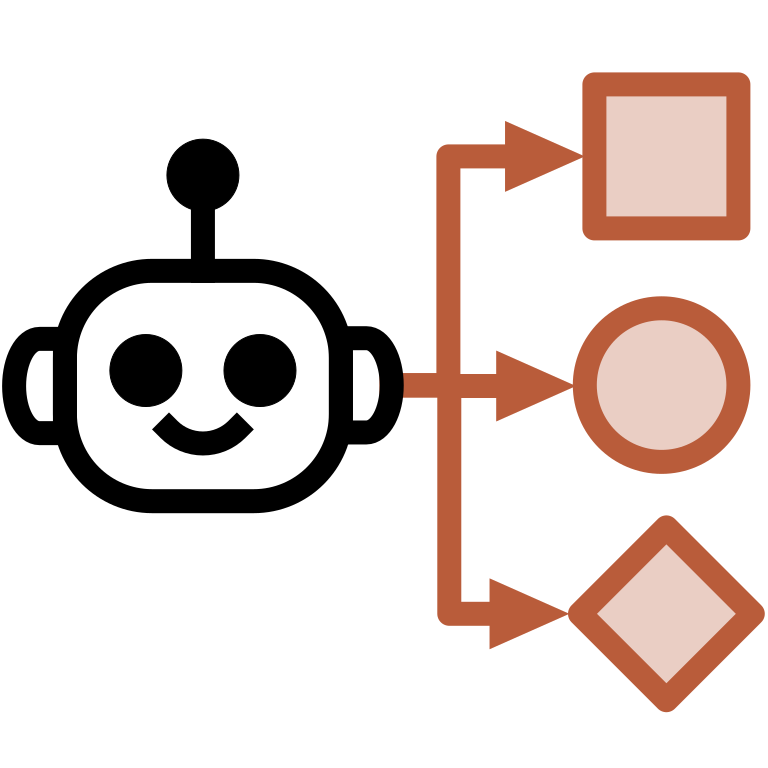
core.dispatch parallel fan-out (RFC 0118) dispatches a heterogeneous worker set — each nextWorkerIds[i] is a distinct workflow id — and RFC 0022's per-worker input mapping is keyed by workflow id, so it cannot give N instances of one workflow distinct inputs. This RFC adds the one missing wire concept for data-parallel fan-out: an optional, index-aligned nextWorkerInputs array on the next-worker OrchestratorDecision, so a supervisor can fan one childWorkflowId out over N runtime items, each child receiving a distinct per-item input. It is additive, capability-gated (capabilities.dispatch.perItemInput), and replay-deterministic because the items are frozen in the recorded runOrchestrator.decided event.
Motivation
The canonical "map a workflow over a list" pattern — run one per-item workflow for every element of a runtime-computed collection — is a first-class capability in every comparable engine (Temporal child-workflow fan-out, AWS Step Functions Map state, LangGraph Send). OpenWOP's core.dispatch supports fan-out (RFC 0118) and input mapping (RFC 0022), but not their composition over homogeneous workers with distinct data.
Concretely (OpenWOP reference-app ADR 0255, "segment-winback"): a supervisor resolves a marketing segment to N contactIds and wants to run the single-contact re-engage-contact workflow once per contact. Today this is inexpressible:
- The cardinality is already expressible —
nextWorkerIdshas no uniqueness constraint, so['re-engage','re-engage','re-engage']legally dispatches three children of one workflow. - The per-item input is not — RFC 0022's
perWorkerInputMappingsis keyed byworkflowId, and the defaultinputMappingprojects the same parent variables into every child. All N children therefore receive the same input. A host that ran this today would process one contact N times and skip the other N−1 — a silent, severe correctness (and, for send-side workflows, spend) hazard.
The workflow engine is the right place to close this: fan-out, concurrency bounding, join, and replay-determinism already live in core.dispatch. A host-side "create N child runs directly" workaround would stand up a second fan-out/join/concurrency implementation beside the primitive — the anti-pattern RFC 0118 exists to avoid. The minimal wire addition is a per-index input source on the dispatch decision; nothing else in the fan-out machinery changes.
Proposal
Wire-shape changes
1. New optional field nextWorkerInputs on NextWorkerDecision (orchestrator-decision.schema.json).
An index-aligned array of per-child input objects. When present, the host MUST project nextWorkerInputs[i] into the inputs of the child dispatched for nextWorkerIds[i].
nextWorkerInputsis OPTIONAL. When absent, dispatch behaves exactly as today (RFC 0118/0022): every child receives only theinputMapping/perWorkerInputMappingsprojection.- When present,
nextWorkerInputs.lengthMUST equalnextWorkerIds.length. A host consuming anext-workerdecision whosenextWorkerInputs.lengthdiffers fromnextWorkerIds.lengthMUST fail the dispatch node with avalidation_error(error-envelope.md) and MUST NOT dispatch any child from that decision. - Each
nextWorkerInputs[i]is a flat-or-nested JSON object of child input variable names → values. - Merge precedence. Child
i's effective inputs are theinputMapping/perWorkerInputMappingsprojection from parent variables (RFC 0022), withnextWorkerInputs[i]merged over it — a key present in both resolves to thenextWorkerInputs[i]value. Per-item literal data is the more specific source and wins. (See Unresolved question 1.)
2. New capability descriptor capabilities.dispatch.perItemInput — a boolean prose descriptor documented in capabilities.md §dispatch, alongside the RFC 0118 capabilities.dispatch.* descriptors (fanOutSupported, maxFanOut, joinModes), which are themselves prose-only. capabilities.dispatch is not enumerated in capabilities.schema.json (the root capabilities object is additionalProperties: true), so advertising capabilities.dispatch.perItemInput: true is wire-legal with no capabilities.schema.json change. (See Unresolved question 2 / gap G2.)
- A host that advertises
capabilities.dispatch.perItemInput: trueMUST honornextWorkerInputsas specified above. - A host that does not advertise it, upon consuming a
next-workerdecision carrying a non-emptynextWorkerInputs, MUST fail the dispatch node with avalidation_errorand MUST NOT dispatch. It MUST NOT silently dropnextWorkerInputsand dispatch N identically-inputted children — silent-drop is the exact correctness/spend hazard this RFC closes, so the gate fails closed. (Old hosts predating this RFC reject the field automatically:OrchestratorDecisionisadditionalProperties: false, so a strict validator refuses the unknown property — the fail-closed behavior is consistent with the existing schema.)
3. Homogeneous cardinality is unchanged. This RFC adds no new fan-out mode: repeated ids in nextWorkerIds already express "one workflow, N children" (RFC 0118 §fan-out; quorum ≤ nextWorkerIds.length counts duplicates). fanOutPolicy, joinPolicy, maxConcurrency, iterationCap, and DispatchConfig are untouched.
Replay determinism (normative)
nextWorkerInputs rides on the OrchestratorDecision, which is recorded verbatim in the runOrchestrator.decided event (run-orchestrator-decided-event.schema.json, decision field). On :fork/replay the host MUST re-read the recorded decision — including nextWorkerInputs — and MUST NOT recompute the per-item inputs. The items are frozen at decision time (computed once by the supervisor node), so a forked or replayed run reproduces byte-identical children. This mirrors the RFC 0118 mergeOrder replay clause: the parent re-folds recorded child terminals rather than re-invoking, and here it re-reads recorded inputs rather than re-deriving.
Bounds + conservative-path (normative, unchanged)
nextWorkerIds.length(=nextWorkerInputs.length) counts againstmaxConcurrency,capabilities.dispatch.maxFanOut, anditerationCapexactly as RFC 0118 today — each dispatched child is one dispatch-iteration (RFC 0118 §Resolved Q5). A host MUST NOT silently drop children abovemaxFanOut; it surfaces the existing over-cap behavior.- CP-2 preserved. Per-item input is a scheduling input to child construction, not a run-DAG mutation. The parent's static template DAG is unchanged; N children of one
childWorkflowIdis one dispatch node executing N child-constructions — the existing repeat-id case with data attached.
Positive example
runOrchestrator.decided.decision:
{
  "kind": "next-worker",
  "nextWorkerIds": ["re-engage-contact", "re-engage-contact", "re-engage-contact"],
  "nextWorkerInputs": [
    { "contactId": "c_001" },
    { "contactId": "c_002" },
    { "contactId": "c_003" }
  ]
}
Under fanOutPolicy: 'parallel' on a host advertising capabilities.dispatch.perItemInput: true: three concurrent children of re-engage-contact, receiving inputs.contactId of c_001 / c_002 / c_003 respectively (each also receiving any inputMapping projection), joined per joinPolicy.
Negative examples (each a validation_error, no child dispatched)
// length mismatch: 2 inputs for 3 workers
{ "kind": "next-worker", "nextWorkerIds": ["w","w","w"], "nextWorkerInputs": [ {"contactId":"c1"}, {"contactId":"c2"} ] }
// host does NOT advertise capabilities.dispatch.perItemInput → fail closed, never dispatch N identical children
{ "kind": "next-worker", "nextWorkerIds": ["w","w"], "nextWorkerInputs": [ {"contactId":"c1"}, {"contactId":"c2"} ] }Compatibility
Classification: additive (COMPATIBILITY.md §2.2).
- No required→optional, removal, or retype.
nextWorkerInputsis a new OPTIONAL property onNextWorkerDecision; existing decisions omit it and are byte-identical.capabilities.dispatch.perItemInputis a new OPTIONAL boolean descriptor (absent ⇒false). - No event-shape change of meaning.
runOrchestrator.decided,node.dispatched,core.dispatch.fanOut/joinare unchanged;nextWorkerInputsis carried inside the existingdecisionfield. - No endpoint contract, error-code, or HTTP-status meaning change. The length-mismatch and unadvertised-capability failures reuse the existing
validation_errorenvelope. - No
MUSTrelaxed. All existing RFC 0118/0022 MUSTs stand.
Forward-compatibility clauses.
- A host that does not advertise
capabilities.dispatch.perItemInputfails closed on a decision carrying the field (rejects, never mis-dispatches). This is a deliberate stricter-than-ignore choice, and it is consistent with the existingOrchestratorDecisionadditionalProperties: falsestrictness — an old validator already rejects the unknown property. Silent-drop-and-dispatch is the one behavior the spec forbids, because it produces N identical children (the motivating bug). - Existing v1 conformance passes are unaffected: no current scenario emits
nextWorkerInputs, and hosts not advertising the capability are exempt from the new scenario (capability-gated).
No migration tooling is required (additive, no old shape to detect).
Conformance
Existing adjacent coverage: conformance/src/scenarios/dispatch-fanout-parallel.test.ts (RFC 0118 parallel fan-out + join), dispatch-input-mapping.test.ts / dispatch-output-mapping.test.ts (RFC 0022 mapping), orchestratorDispatch.test.ts, dispatchLoop.test.ts.
Landed scenario — dispatch-per-item-input.test.ts (suite 1.49.0), in two layers:
- Always-on, server-free schema legs (run in the CI spec-corpus gate, no host): a well-formed index-aligned
nextWorkerInputsvalidates onNextWorkerDecision; a decision omitting it stays valid (additive/back-compat); a non-object item and a non-array are rejected; a mis-namedperItemInputsis rejected byadditionalProperties:false(the pre-0126 fail-closed rail); and a length-mismatch is ADMITTED at the wire — array-length equality withnextWorkerIdsis not JSON-Schema-expressible, so it is a runtime MUST driven in the behavioral layer. - Capability-gated behavioral legs (gated on
capabilities.dispatch.perItemInput: true, over thePOST /v1/host/sample/dispatch/per-itemseam; soft-skip on 404/403 until a host wires the seam), each viadriver.describe('node-packs.md §core.dispatch per-item input', '<requirement>'): (1) per-index projection, (2) merge precedence (per-item value wins overinputMappingon key collision, G1), (3) length-mismatch ⇒validation_error, zero children, (4) replay-freeze (a:fork/replay re-reads the recorded per-item inputs verbatim), and (5) the fail-closed gate — a host not advertising the capability that receives a non-emptynextWorkerInputssurfacesvalidation_errorand dispatches nothing.
Single-witness evidence: the graduation is witnessed by the openwop-app reference host (PR #1278), whose own dispatch-per-item-input-executor.test.ts (5/5) drives projection, precedence (G1), the fail-closed gate, length-mismatch, back-compat, and the replay-safe recorded-decision re-read (R5) through a real core.dispatch node + real subWorkflowDispatcher. The host is honest-off (behind an env flag) until the post-graduation advertisement flip.
Carried-forward conformance gaps (named per the register sweep; none is graduation-critical wire surface): the POST /v1/host/sample/dispatch/per-item seam is not yet wired in the in-repo reference hosts, so the behavioral legs above soft-skip in the server-free suite (precedence + replay-freeze are therefore reference-host-witnessed today, not yet server-free-pinned — gap G5); the in-memory/sqlite hosts + python do not yet implement (gap G6, INTEROP-MATRIX cells —); the dispatch.perItemInput INTEROP-MATRIX column populates when openwop-app advertises post-flip (risk R4). A dedicated fixture is not required (the scenario builds decisions inline).
Alternatives considered
1. Do nothing / defer (status quo). Segment-wide map-over-collection stays inexpressible; ADR 0255 stands blocked. Rejected — this is a canonical, broadly-useful engine capability, not a niche. 2. Host-side fan-out — a feature node creates N child runs directly via run-creation, bounding concurrency and joining itself. Rejected: re-implements core.dispatch's fan-out/concurrency/join/replay outside the primitive — a second dispatch system that will drift from the first (the exact "parallel architecture" RFC 0118 consolidates). 3. A new dataParallel DispatchConfig mode carrying childWorkflowId + items in static config. Rejected: the items are runtime data (resolved from an upstream node, e.g. a segment), so they cannot live in registration-time config; and it duplicates the cardinality that nextWorkerIds already expresses. The decision-carried field is both smaller and already on the recorded-event replay path. 4. Index-keyed perWorkerInputMappings (extend RFC 0022 to key by fan-out index instead of workflowId). Rejected: perWorkerInputMappings values are parent-variable mappings, not literal data; per-item data is not a mapping. Conflating the two overloads RFC 0022's mapping semantics.
Unresolved questions
_Resolution status recorded at Accepted (register sweep, 2026-07-04)._
1. Merge precedence (Proposal §1). RESOLVED — per-item overrides (most-specific wins). nextWorkerInputs[i] projects over the RFC 0022 inputMapping projection; a key present in both resolves to the per-item value. Pinned in node-packs.md §core.dispatch per-item input + conformance assertion 2 + the openwop-app witness (test 2). (Closes gap G1.) 2. Capability name. RESOLVED — capabilities.dispatch.perItemInput (describes the wire delta). Landed as a prose descriptor in capabilities.md §dispatch (matching the prose-only dispatch. descriptors); no capabilities.schema.json change. (Closes gap G2.) 3. Item value constraints. CARRIED FORWARD (named open gap). nextWorkerInputs[i] permits arbitrary nested JSON (matching unconstrained child inputs); no hard per-item depth/size cap is specified. The bounded-work guarantee rests on the existing decision-event size limits (the whole decision, including nextWorkerInputs, rides one runOrchestrator.decided event and is bounded by the host's event-size ceiling) plus maxFanOut/maxConcurrency/iterationCap bounding child count. A dedicated per-item size cap is deferred to a follow-up if a resource-exhaustion signal appears in practice (gap G3 / risk R2, tracked). This is not a wire-shape commitment — a later cap is additive. 4. Mismatch error timing. RESOLVED — runtime validation_error only. The decision is produced at run time, not registration time, and the emitting node's typeId is not known-data-parallel at POST /v1/workflows; there is no registration-time signal. Length-mismatch and unadvertised-capability both fail the dispatch node at run time, dispatching no child. (Closes gap G4.) 5. Per-item output symmetry. RESOLVED — out of scope for 0126. Per-child output* already maps via RFC 0022 outputMapping per completed child; no per-item output projection is added here. A future RFC may revisit if a per-item output need appears.
Implementation notes (non-normative)
- Executor delta is surgical. The reference executor's fan-out arm already threads the fan-out index into child construction (
dispatchChild(childWorkflowId, idx)in the OpenWOP-app reference host); the only change is projectingdecision.nextWorkerInputs?.[idx]into that child's inputs after the RFC 0022 mapping. No change tofanOutPolicy/joinPolicy/maxConcurrencyhandling. - Supervisor side (host application concern, no new wire). A pure supervisor node reads an upstream collection (e.g. resolved segment members) and emits the
next-workerdecision withnextWorkerIds = [childId] × N+nextWorkerInputs = items.map(...). The per-item child's own idempotency guard (e.g. an enroll-CAS) makes a re-dispatched wave duplicate-safe. - Sequencing.
Draft(this doc, comment window) →Active(unresolved questions 1–4 closed, scenarios sketched) →Accepted(schemas + spec prose + conformance scenario + in-memory/sqlite reference hosts landed). No cross-cut (CC-N) needed — additive, no breaking impl assumption. - Consumer. OpenWOP-app ADR 0255 §deferred is the first consumer; its executor arm + supervisor node +
campaign-journeys.segment-winbackchain land after 0126 reachesAccepted.
Acceptance criteria
- [x] Spec text merged (
node-packs.md §core.dispatchper-item-input clause;capabilities.mdperItemInputdescriptor). — #825. - [x]
orchestrator-decision.schema.json(nextWorkerInputs) updated;additionalProperties: falsepreserved onNextWorkerDecision; positive + negative examples added. G2 resolution: the capability landed as a prose descriptor incapabilities.md §dispatch(matching the existing prose-onlydispatch.*descriptors);capabilities.dispatchis not enumerated incapabilities.schema.json, so there is nocapabilities.schema.jsondiff. — #825. - [x] OpenAPI / AsyncAPI: no endpoint/channel change (the decision rides the existing
runOrchestrator.decidedevent) — confirmed, no diff. - [x] At least one conformance scenario (
dispatch-per-item-input.test.ts) covering per-index projection, length-mismatch, precedence (overinputMapping), the fail-closed capability gate, and the length-mismatch/back-compat cases. Server-free schema legs always-on; behavioral legs capability-gated (soft-skip until a host advertises). — #825, suite1.48.0 → 1.49.0. - [x]
CHANGELOG.mdentry under[Unreleased] → ### Added. — #825 (Active surface) + this graduation entry. - [x] Single-witness reference-host implementation — openwop-app (implementer #1) landed the host executor arm (PR #1278):
subWorkflowDispatcher.perItemInputsprojected over the RFC 0022 mapping (per-item override),decision.nextWorkerInputs[idx]projected into each child on both the parallel fan-out and sequential-loop arms, the fail-closed gate (non-advertising host + length-mismatch ⇒validation_error, 0 children), and replay-safe re-read of the recorded decision (CP-2). Witnessdispatch-per-item-input-executor.test.ts— 5/5 green on a realcore.dispatchnode + real dispatcher (distinct-per-item projection not N-identical; per-item overridesinputMapping; fail-closed unadvertised; length-mismatch closed; no-nextWorkerInputsback-compat); 64 existing dispatch/scheduler tests still green. Host advertises honest-off (capability behind an env flag, default false) until this graduation; the flip to advertiseperItemInputis a one-line follow-up now unblocked. Graduated single-witness under the bootstrap steward waiver (RFC 0120/0121/0125 precedent). Deferred hosts (recorded, G6): the in-memory / sqlite conformance reference hosts + the Python host are not required for this graduation — their INTEROP-MATRIX cells stay—until they implement (R4 tracked).
References
- RFC 0118 — Parallel sub-workflow fan-out and join (the parallel path +
mergeOrderreplay clause +capabilities.dispatch.*descriptors this extends). - RFC 0022 —
core.dispatch+core.subWorkflowruntime variable mapping (inputMapping/perWorkerInputMappings, keyed by workflowId — the limitation this composes with). - RFC 0007 —
core.dispatchnode + the dispatch loop (CP-2 conservative-path commitment). - RFC 0006 §C —
OrchestratorDecisionshape (next-worker/ask-user/terminate). spec/v1/node-packs.md §core.dispatch,spec/v1/capabilities.md,spec/v1/replay.md.- OpenWOP-app ADR 0255 — "segment-winback fan-out is an RFC-gated engine feature, not a chain step" (the motivating finding + first consumer).
- Prior art: AWS Step Functions
Mapstate; Temporal child-workflow fan-out; LangGraphSendAPI.