Status: Stable · v1.x (2026-07-02) — RFC 0122
Accepted(2026-07-02; graduated 2026-09-03 under RFC 0174 §D.1). Normative surface for RFC 0122 — Self-hosted runner (remote-driven local execution): a host routes a run's per-step model/tool dispatch to a user-controlled runner that dials OUT to the host and holds local credentials the host cannot reach. Companion tocapabilities.md(selfHostedRunner),stream-modes.md(the SSE framing +Last-Event-IDresume this reuses),replay.md(per-step persistence + fork), and the BYOK/credential surface of RFC 0046/0108/0121. RFC 0122 isAccepted: hosts MAY advertiseselfHostedRunner.supported: true(RFCS/README.mdrecords the graduation); an earlier revision of this banner forbade it after the RFC had already graduated. Keywords MUST, SHOULD, MAY, MUST NOT, SHOULD NOT follow RFC 2119. Status legend perauth.md.
Why this exists
Two Accepted surfaces establish the pieces but stop at a boundary a hosted control plane cannot cross. RFC 0108 lets a host dispatch to an operator-configured endpoint — but only one the host can reach; a multi-tenant cloud host cannot reach a user's loopback endpoint. RFC 0121 lets a run use a personal subscription — but only via a client the executing process can run; on a stateless cloud host there is no such client and no user login.
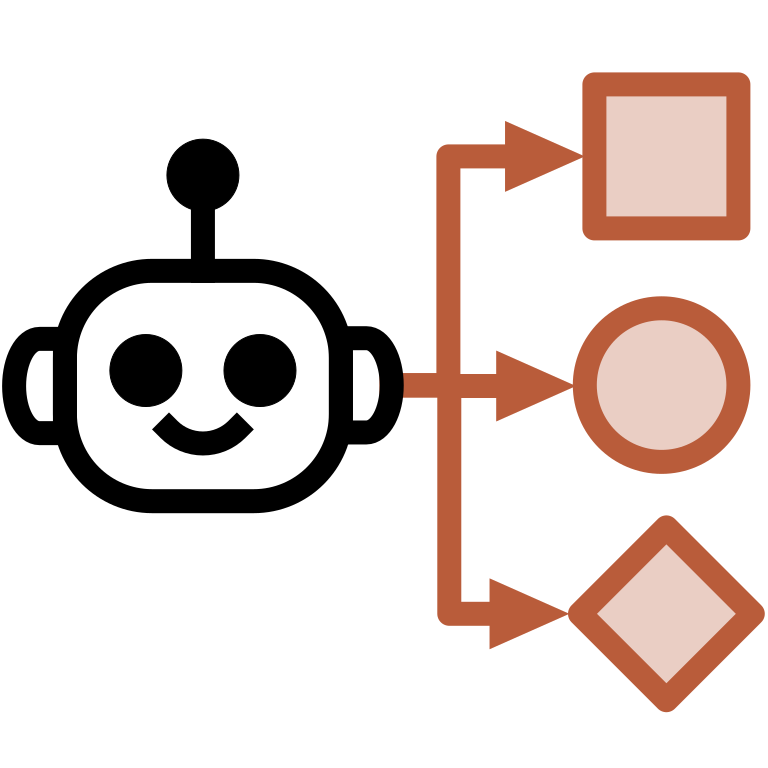
The missing primitive is execution locality: a way for the executing side to be a user-controlled runner that dials the host, so the host orchestrates while the runner holds the credential and does the work — the same shape as CI self-hosted runners. The cleanest mental model: today's co-located loopback shim is the degenerate case of a runner — "a runner on localhost the host can POST to directly." A remote runner is the same per-step dispatch unit with the connection direction flipped: the runner dials OUT, so the user's machine needs no inbound network exposure.
The channel is the right thing to specify because runner↔host is a wire contract two independent implementations must interoperate over (framing, dispatch routing, result delivery, liveness, runner-to-host auth), and because advertising it is a capability handshake other clients must discover.
Roles
- Host — the control plane (MAY be multi-tenant/cloud). Owns run identity,
persistence, replay, and the client-facing API. Holds no runner credential material.
- Runner — a user-controlled process (a laptop, a
clients/daemon, a desktop
app) that authenticates to the host, then receives dispatch work over a persistent channel and returns results. Holds the local credentials (subscription CLI login, private endpoint). Bound to exactly one owning subject (the RFC 0048 principal).
Registration + channel
Runner-to-host authentication
A runner opens a persistent connection to the host and authenticates with a host-minted, subject-scoped runner bearer — a revocable, non-provider token the host issues for the owning subject. The host records a SelfHostedRunnerRegistration (self-hosted-runner-registration.schema.json): { runnerId, subject, capabilities }, where subject is the stable RFC 0048 principal the host stamps on the backing run's run.metadata (NOT a fresh id). The runner bearer MUST NOT be a provider credential; compromise of the host MUST NOT yield any provider credential (§Trust boundary).
The channel (SSE outbound + POST result)
OpenWOP has no WebSocket transport; the runner↔host channel reuses the existing SSE framing and invents no new wire shape:
- Receive (dispatch). The runner opens a long-lived
GET(SSE) stream to the
host and receives SelfHostedRunnerDispatchFrame (schema) frames using the canonical event:/data:/id: framing of stream-modes.md. The channel is runner-initiated (outbound), so the runner needs no inbound network exposure.
- Return (result). The runner POSTs a
SelfHostedRunnerResultFrame
(schema) back to the host over ordinary HTTP for each dispatch it completes.
The dispatch cursor + resume
Each dispatch frame carries a per-runner monotonic dispatch cursor seq. This cursor is a DISTINCT sequence from the run event-log sequence and the two MUST NOT be conflated — reusing the event-log sequence (e.g. an ETag-from-seq derivation) breaks resume dedup, because dispatch to a given runner is not 1:1 with event-log advancement. A reconnecting runner resumes by sending Last-Event-ID set to the last dispatch cursor it processed; the host resumes delivery after that cursor per stream-modes.md §Resumption.
At-most-once dispatch
Last-Event-ID resume alone is insufficient, because a runner side effect (a subscription-CLI turn = real spend; a tool action) is not itself idempotent. Therefore, beyond the runner cursor, the host MUST drop — not re-dispatch — any {runId, stepId} whose result is already persisted. The {runId, stepId} pair is the at-most-once idempotency key; a runner MUST return its result under the same pair it received.
Behavior (normative)
1. Subject isolation. A host MUST NOT route a run's dispatch to a runner not owned by the run's subject. When addressing by capability-match (any free runner for the step's provider/model/tool), the host MUST filter on subject FIRST, then capability — never the reverse — so a capability match can never route a subject's step to another subject's runner (subject-first match — a normative MUST verified by the gated self-hosted-runner conformance scenario). 2. Credential non-transit. A runner credential (subscription login, endpoint key) MUST NOT transit the host, and MUST NOT appear in any dispatch frame, result frame, run event, run result, debug bundle, or log. The host sends inputs, receives output, and never sees the credential (runner-credential-non-transit; mirrors the BYOK SR-1 rule). 3. Untrusted transport. A host MUST treat a runner as untrusted transport: runner-returned output re-entering an agent loop MUST be fenced as untrusted (<UNTRUSTED>), consistent with the existing tool-output fencing requirement (runner-output-untrusted-transport). 4. Per-step granularity. A host routes only individual model/tool dispatch steps, never a whole run. The host remains the sole orchestration/persistence/ replay authority; the runner is a stateless dispatch executor. A dispatch frame carries one step ({ runId, stepId, seq, kind, … , inputs }); the result frame carries that step's { runId, stepId, seq, output }. A host MAY route only a subset of dispatch kinds (advertised via selfHostedRunner.dispatchKinds) — e.g. model first, tool later behind the same gate. 5. Liveness. A dispatch routed to a runner that has gone away MUST fail with a distinct, retriable error runner_unavailable, and MUST NOT hang indefinitely. 6. Truthful advertisement. A host MUST NOT advertise selfHostedRunner.supported: true unless it honors this channel (accepts registrations, routes matching dispatch, delivers results). A dishonest claim is non-conformant and MUST fail OPENWOP_REQUIRE_BEHAVIOR=true. Because RFC 0122 is Accepted (2026-07-02): hosts MAY advertise the capability; this line said the opposite until the RFC 0174 §D.1 sweep (2026-09-03).
Trust boundary + replay
- Auth. Runner↔host auth is a host-minted, subject-scoped bearer — revocable,
non-provider. Compromise of the host does not yield provider credentials.
- Outbound-only. The runner channel is runner-initiated; the user's machine
needs no inbound exposure.
- Replay reads persistence; never re-dispatches. Each dispatch result is persisted
as a normal step record. On POST /v1/runs/{runId}:fork (replay), the host reads the persisted step output and MUST NOT re-dispatch to the runner — so replay is deterministic even if the original runner is long gone (replay.md).
- Fork re-routes; no runner pin. A fork of a run whose steps executed on a now-
absent runner re-routes future (post-fork) dispatch to any runner owned by the run's subject with a matching capability; it MUST NOT pin to the original runnerId.
- ToS posture out of scope. What the runner does (e.g. driving a subscription
CLI) is the runner operator's at-own-risk decision (RFC 0121); this doc governs only the host↔runner contract.
Capability
Advertised as the OPTIONAL root block selfHostedRunner on GET /.well-known/openwop (capabilities.md §selfHostedRunner, modeled on the RFC 0073 document-root layout beside agents/connections/a2a):
"selfHostedRunner": { "supported": true, "dispatchKinds": ["model"] }supported is REQUIRED when the block is present; dispatchKinds is OPTIONAL. The per-subject SelfHostedRunnerRegistration record is runtime state and MUST NOT appear on /.well-known/openwop.
Examples
Positive. A hosted control plane advertises selfHostedRunner; a user's desktop app registers a runner for subject user_42 with capabilities.providers: ["anthropic"]. The user, from a phone, starts a run whose model step is an anthropic subscription provider (RFC 0121). The host matches a free runner owned by user_42, sends a model dispatch frame {runId, stepId, seq, provider:"anthropic", model, inputs}, the runner runs claude -p under the user's local login and POSTs back {runId, stepId, seq, output}. The host persists and streams the completion. The subscription token never left the laptop.
Negative (rejected) — cross-subject routing. A host attempts to match subject A's step to subject B's runner. MUST be refused (subject-first match — behavior §1).
Negative (rejected) — credential on the wire. A runner attaches a credential field to a result frame. The host MUST strip/reject it; the credential MUST NOT be persisted or logged (runner-credential-non-transit, additionalProperties:false on the frame).
Liveness. The user closes the laptop mid-run. The next dispatch fails with retriable runner_unavailable; the run does not hang. On a later fork, future dispatch re-routes to any runner user_42 has registered — persisted steps replay from persistence.
Open spec gaps
Absorbed into
spec/v1/gaps.json(RFC 0174 §E.3, 2026-09-03). The 4 row(s) this table carried are nowopenwop.gap.spec.self-hosted-runner.<local>entries with a disposition and a witness class, one namespace with every RFC register (RFC 0166 §B). The table is retired; do not add rows here.
References
- RFC 0122 — Self-hosted runner (remote-driven local execution)
capabilities.md— theselfHostedRunneradvertisementstream-modes.md— SSE framing +Last-Event-IDresumptionreplay.md— per-step persistence +:fork- RFC 0108 · RFC 0121 · RFC 0048
- Schemas:
self-hosted-runner-dispatch-frame.schema.json·self-hosted-runner-result-frame.schema.json·self-hosted-runner-registration.schema.json